You have a paid AI subscription. You prompt it every day — emails, summaries, first drafts, research. You feel comfortably ahead of the curve.
Now the uncomfortable question: has your output actually changed? Or are you doing the same work you always did, only with a shinier tool?
Owning the Tool Is Not Using It
A gym membership does not make you fit. Showing up and repeating the same three machines does not make you fit either.
What makes you fit is a plan matched to your goal — the right exercises, in the right order, with steadily increasing effort.
An AI subscription works the same way, and there are two gaps between buying it and benefiting from it.
The first gap lies between owning the tool and using it — most professionals I meet have crossed this one; they log in daily.
The second gap lies between using AI and using it with a method, so that your effort compounds instead of evaporating. Very few have crossed that one.
Using AI Is Not Being Productive
Let me use myself as the example, because I made every mistake I am about to describe.
I started using AI seriously in 2023, first on free ChatGPT, then on the paid plan. Even when I was writing weekly or monthly articles for the same clients and hence
- the style guide never changed,
- the brand voice never changed and
- the client specifications never changed,
every single time I started from scratch.
I typed the full prompt, pasted the same context, ran two or three iterations and copied the result out. I felt productive. In reality, my process had not improved at all. Every week I re-entered instructions the tool had already seen dozens of times, and none of that effort improved what I was doing the next task. In a word, no continuous improvement.
This is the trap of the second gap I described above — daily use with no method behind it. The tasks feel faster, and the saved minutes leak into more low-value busyness.
Faster busyness is still busyness.
Being Productive Is Not Being Impactful
Here is the fallacy nobody talks about. Even genuine time savings mean little if the output stays the same.
Producing ten mediocre drafts in the time that produced just one is not progress—it is faster mediocrity.
The measure that matters is not “how quickly do I finish the same work?” but “what can I deliver now that I could not deliver before?“
My own answer changed only when my methods changed.
In early 2025 I moved to Claude. Still prompting at first, still level 2. But then I began encoding the unchanging parts of my work — client specifications, style guides, output formats — into reusable skills.
Recently, I scheduled recurring deliverables onto weekly and monthly runs that execute without me starting them.
The results have been more than just saved hours. I took on more work, revision rounds with clients dropped and I reclaimed time for the things a to-do list never protects — my writing and my family.
The Four Levels of AI Maturity
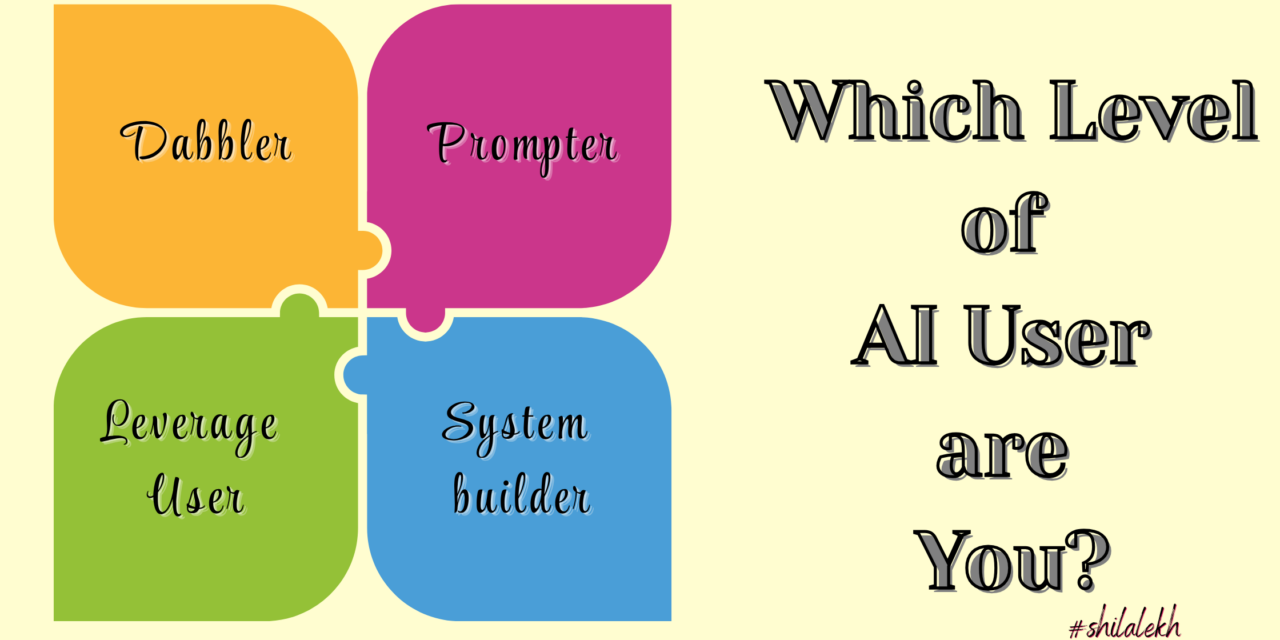
If you want to know whether you are using AI correctly, do not ask how often you use it. Ask which of these describes you:
- The Dabbler: Occasional questions, treated like a smarter search engine.
- The Prompter: Daily use, but every task starts from zero. Context is retyped, results are copied out, nothing compounds.
- The System-Builder: Repeating context — clients, formats, standards — lives in reusable instructions. Each task starts from eighty percent done.
- The Leverage-User: Recurring work runs on a schedule. Your attention goes only to judgment, refinement, and the work only you can do.
In my experience, most paid subscribers sit at level 2 and sincerely believe they are at level 4. I did the same for over a year.
There Is No Single Right Way
A fair objection I can almost hear: who decides what “correctly” means? Not me, and not any consultant worth hiring.
There are always multiple valid ways to work with AI, and the right one depends on what you do, why you do it, and where you currently stand on that ladder.
Anyone who pushes one universal method is selling you comfort (that too theirs!), not outcome. The correct way is simply the one that moves you one level up from wherever you actually are.
Three Questions Before You Close This
Sit with these 3 questions for a moment:
- What information do you retype into AI every single week?
- Where does the time AI saves you actually go?
- What can you deliver today that you could not deliver a year ago?
If your honest answer to the last one is “nothing much,” you are not underusing AI. You are misusing your own time with it, and that is the one resource no subscription upgrade will ever refund