

About a year ago, I came across a LinkedIn piece confidently declaring that tier 2 and tier 3 cities are India’s next talent goldmine. The data was compelling. The optimism was infectious. But I having run businesses in a tier 3 city myself, I was skeptical.
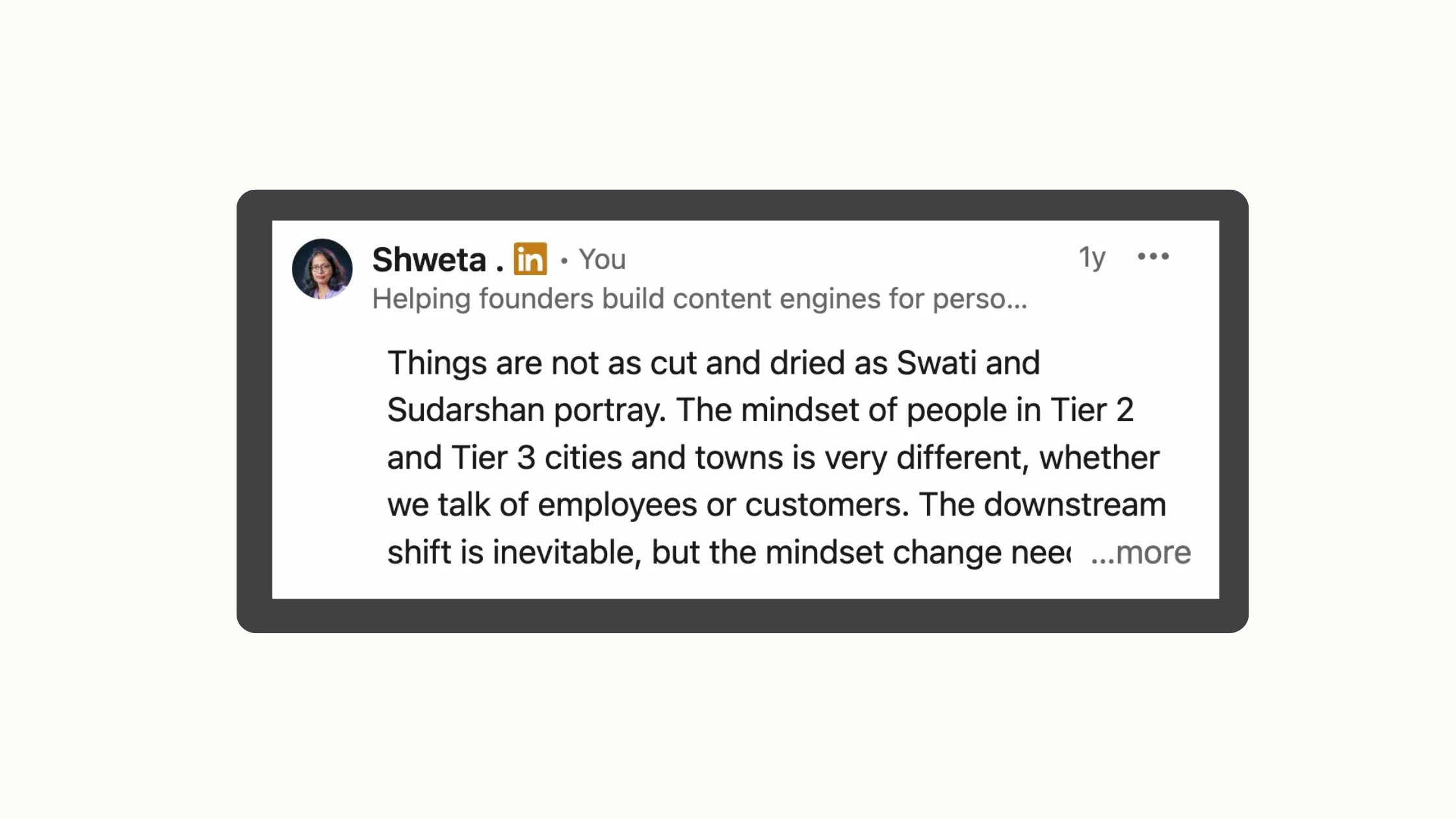
Here is what I think: Things are not as cut and dried as the article portrayed. The mindset of people in tier 2 and tier 3 cities is very different — whether we talk of employees or customers. The downstream shift is inevitable. But the mindset change needed to make it work? Nobody was talking about that.
The article was not wrong. It was incomplete. And for founders actually operating or planning to operate in these cities, incomplete is almost as dangerous as wrong.
What the Headlines Are Getting Right
Let me be fair to the data first.
Business Standard reports that cities like Thiruvananthapuram, Coimbatore, Jaipur, and Indore now contribute 12-15% of India’s tech talent. ALP Consulting’s 2025 hiring trends report clocked a 50%+ year-on-year spike in IT hiring in smaller cities in the first half of 2025, compared to just 12-15% growth in tier 1 cities.
And one of the first success stories is definitely Zoho. It has built an entire operating philosophy around hiring locally, training in-house, running a hub-and-spoke model with close to 2,000 employees across tier 2/3 offices.
The broad direction is real. Companies moving to smaller cities are reporting better retention, lower costs, and access to talent that metros are ignoring.
But here is the thing. Every city in those reports — Jaipur, Indore, Coimbatore, Bhubaneswar — is a tier 2 city with an expanding economy, a growing startup ecosystem, and a diversified workforce. Bokaro is none of those things. And my guess is that most tier 3 cities are more Bokaro than Jaipur.
That distinction matters enormously when you are the one trying to hire.
The Talent Drain: Your Best People Are Already Gone
Let me tell you what I have observed over two decades of running businesses here. And experiencing peers running their own businesses.
The managers brought in from bigger cities have moved on for one of two reasons. Either they were looking for better opportunities and this was a good stepping stone. Or they needed to be near their parents who had settled around this place, to care for them. Which means that once that caregiving need was no more there, they moved on too.
The city was never where they planned to stay. It was a pitstop.
And the local talent? The most skilled, most ambitious people from these smaller non-metro cities left a long time ago. Especially in Bokaro, where education is good, parents have steady income to ensure excellent higher education. The aspiration of a city like this — shaped by generations of steel plant families — has always been to move outward. A job in Bangalore or Hyderabad or Delhi is not just a career move. It is progress, by the definition that this city handed down to its children.
This is the talent drain that no market report captures (at least it hasn’t yet appeared in my feeds) and it intersects with something deeper. The mental health pressures on young professionals are compounded when the only path to a fulfilling career points away from home.
Calibehr’s research on tier 2/3 hiring notes that companies must navigate infrastructure gaps, skill shortages, and cultural differences when entering these markets. What it does not say — because no market report can say it — is that in a city like Bokaro, the talent pipeline drains before it reaches you.
The Earnings Mismatch: Salary Expectations Have Gone Metro
We used to run a manpower provisioning business here. Covid forced us to close it, but in the short time we ran it, we realised something that still holds true.
The people left behind are much below par. And the companies that are hiring are expecting much more than what is available.
That was pre-Covid. Things have taken a very different turn since then. Post-Covid, there is a new category of worker here — young people who were working full-time in Bangalore, Hyderabad, Delhi, Calcutta, or Mumbai, and have come back to care for ageing parents. They are skilled, experienced and locally present.
But I do not know whether they will stay back after that need is over.
Here is the problem this creates. These returning migrants have metro salaries in their memory and metro benchmarks on LinkedIn. When they look at what a local or localised (coming from metros to reap the business benefits of tier 2 & 3 cities) business can pay, the gap is stark. Your business cannot price its services on metro logic. And it cannot pay on metro logic either because then the whole logic of downstream drift is lost.
It is the same squeeze I wrote about in the context of solopreneur financial resilience. The numbers on paper do not match the reality on the ground, and pretending otherwise is expensive.
Banking is the only exception I see
The only segment I observe genuinely absorbing this returning talent pool is the private banks. And even there, my personal observation — I cannot generalise this — is that the male relationship managers churn quite frequently. Walk into the same branch a few months apart and you are often looking at more new faces than old. The female relationship managers, in my experience, have tended to stay longer. Whether that pattern holds beyond what I have seen, I cannot say. But it is something worth watching if you are in that space.
The Relationship Hiring Trap: When the City Is Also Your Social Network
In a city where everyone knows everyone, hiring through personal networks feels like the natural thing to do. It feels safer, faster, more reliable. And it has worked for us too.
But it’s not just those positive things.
When you hire someone who is connected to you socially — a friend’s cousin, a neighbour’s son, someone your family has known for decades — you take on more than a professional relationship. You take on the social weight of that connection. Holding them to a standard becomes complicated. Having a difficult performance conversation becomes a social incident. And letting them go? That ripples through your community in ways a metro hire simply cannot.
The person you hired as a favour often knows, at some level, that you will not fire them. And they perform, or not, accordingly.
This is not a character flaw in anyone. It is what happens when you try to apply professional structures inside a proximity economy. The steel plant township culture made this worse in Bokaro — when your families are connected across decades and departments, so many professional decisions carry personal weight.
What Has Actually Worked (An Honest Account)
I want to be honest here. We have not solved this. We do not have a clean answer; I doubt if anyone has. But then, hiring has always been difficult, wherever you are hiring. So let me take a stab at suggesting some things from my personal experience.
Over the years — running food outlets, a resort, a computer institute, a manpower business — we have made three shifts that changed how we operate.
Stop hiring for permanence
We used to hire novices and train them. We still do. But what I have accepted is that they are around only till they have learnt enough and have a good length of time on their resume so that they can move to bigger places and grow there. And I cannot even fault them for it. They see that in a bigger city, where the restaurant or the training institute or the software company sees more footfalls, they will work more and hence learn more.
The exposure that we say helps the most in any career — they are simply going to find it.
So now I hire knowing the timeline is limited, extract full value in that window, and release people without resentment. And guess what, sometimes they come back after gaining the experience and you now no you have a keeper.
Watch for the returning migrant window
This is the segment nobody is formally talking about but the private banks have quietly figured it out. Young professionals back home for caregiving are skilled, motivated, and temporarily rooted. The window is uncertain, yes. But it is real.
Design roles that work for someone who may stay two years or may stay five. Do not build your operation around the assumption that they will stay forever, but do not ignore them because they might not.
Build systems that outlast your people
This is the hardest shift, and the most important one. When we ran our computer institute and placed candidates at Bokaro Steel Plant, the model worked because the process was the constant, not any one person. If your business runs on one good manager’s judgment, you have a fragility problem.
The only sustainable response to high turnover is an operation strong enough in its processes that it does not collapse when someone leaves. And in a tier 3 city, someone always leaves. This applies as much to how you protect your business finances as to how you structure your teams — the underlying principle is the same.
Do not build your stability on any single point of failure.
The Real Picture No One Gives You
The LinkedIn articles are right that the talent is here. What they do not tell you is that much of it is in transit — passing through on the way to somewhere else, or waiting until the caregiving is done.
The ones who succeed in building teams in cities like Bokaro are not the ones who ignore this reality. They are the ones who map it first and build accordingly. I wrote about what that looked like for pivoting a business in The Art of the Pivot. The same fundamental principle applies here. You do not fight the terrain. You learn it.
The tier 3 opportunity is real. But it will not be unlocked by metro logic applied at a discount. The mindset shift needed is not just in the employees. It is in how founders and companies enter these markets.
You need to understand the terrain and map your frameworks before you decide how you will proceed.
This is Part 2 of a two-part series on building businesses in tier 3 cities. Read Part 1: What Founders Get Wrong About Tier 3 Cities
Have you hired or tried to build a team in a tier 3 city? What surprised you most? Drop it in the comments.