For most of history, failing at something could cost you far more than your pride.
In feudal Japan, a samurai who failed his lord or lost a battle he should have won was expected to atone through seppuku, ritual suicide by his own short sword. The shame of failure, what the Japanese called haji, was considered heavier to carry than death.
In 1757, the British navy shot one of its own admirals. Admiral John Byng was court-martialled for failing to “do his utmost” to relieve a besieged garrison at Minorca, and executed by firing squad on the quarterdeck of his own ship.
Voltaire’s dry verdict was that the English shot an admiral from time to time “to encourage the others.”
In medieval Padua, a merchant who went broke was stripped to his undergarments and made to strike his bare body against a block of black stone, the pietra del vituperio, while renouncing his goods before a hundred witnesses. Three times over, until the humiliation was complete, after which he was banished from the city.
The word bankrupt comes from the Italian banca rotta, the broken bench of a trader who could no longer pay his debts.
For most of human history, this was the deal: you failed, and the world made sure you felt it.
We’ve since swung all the way to the other end of the spectrum.
We turned failure into something to aim for.
Fail fast. Fail often. Fail forward. Fail early (the worst of them all, which makes failure seem like experiments!).
A whole vocabulary grew up around it, one that treats failing as the work itself, when it’s only ever the toll you pay on the way to succeeding at what you set out to do.
This is the pop culture of failure.
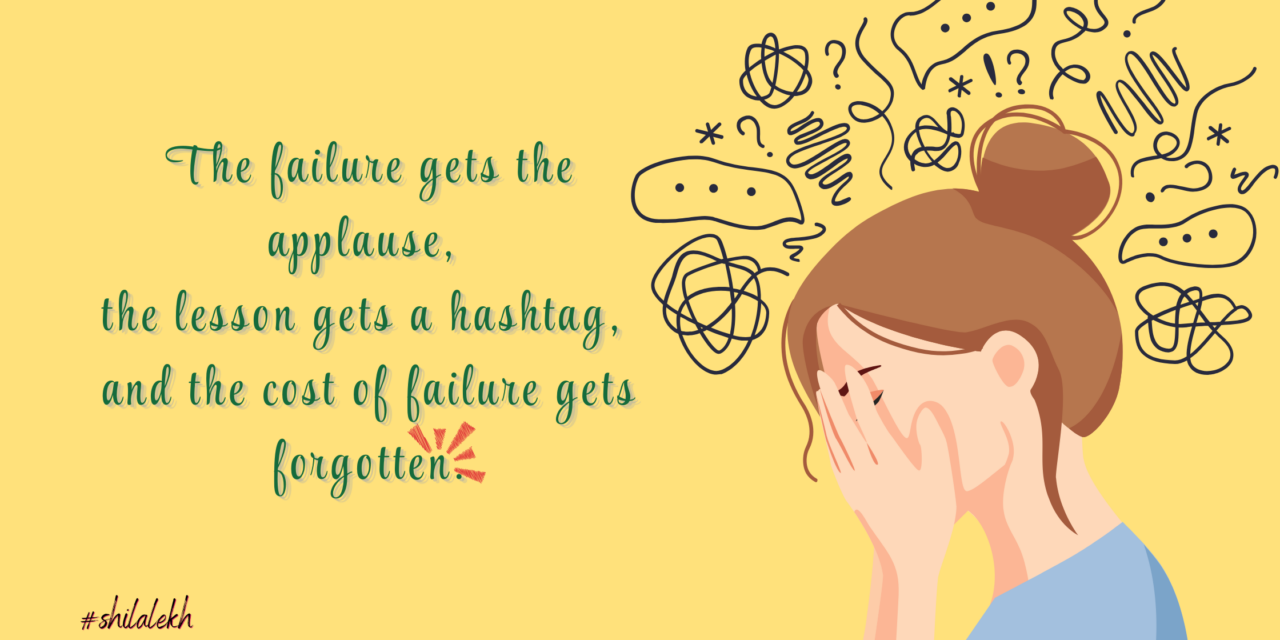
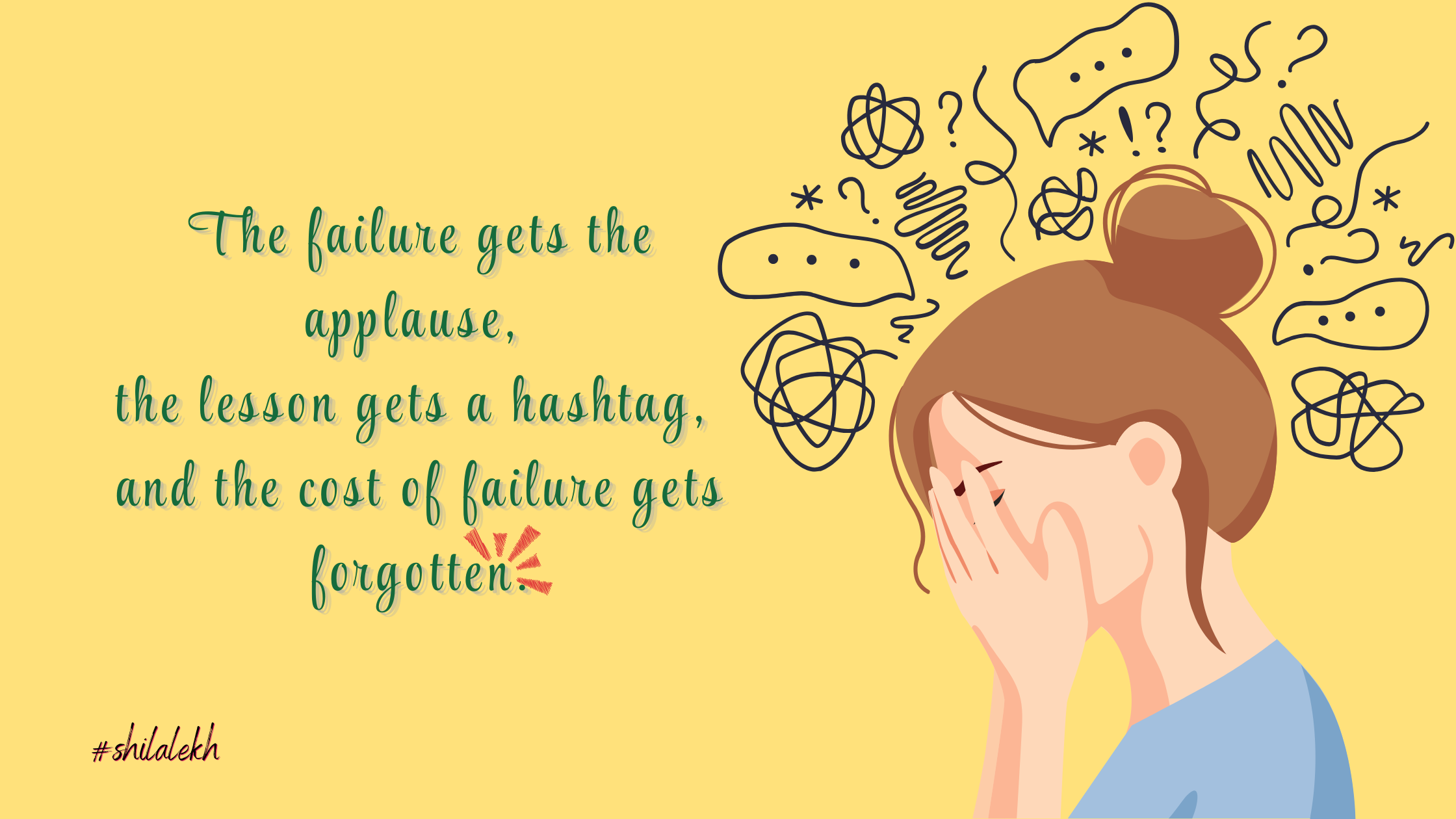
The fall gets the applause, the lesson gets a hashtag, and the cost gets quietly forgotten.
And the swing isn’t baseless, because failure really is everywhere.
Roughly half of all new businesses fail within 5 years, a figure the U.S. Bureau of Labor Statistics has tracked for decades without it moving much. Among venture-funded tech startups, the number people quote is closer to 90%.
Around 49% of people who set a New Year’s resolution in 2024 had dropped it by the end of February, and close to 70% had quit by December.
Between 80 and 95% of dieters regain the weight they lose within 5 years.
In India, nearly a million people sat the 2024 civil services exam for about 1,000 posts. Failing, statistically, is just what attempting looked like.
When something is this common, shaming people for it is both cruel and pointless, and dropping that shame was long overdue. But there is a wide gap between refusing to punish failure and actively celebrating it, and somewhere in the last few decades we sprinted across it.
And the celebration has a real kernel of truth at its center.
The core idea is sound. Lessons do come from failing, and that’s simply how skills get built.
If Virat Kohli keeps nicking the same delivery outside off stump, he wouldn’t post about the beauty of getting out. He would go back to the nets and fix the flaw until the edge stopped coming.
That’s learning from failure.
My quarrel is with everything we’ve piled on top of it.
The vocabulary has become so polished that it now does the opposite of what it promises.
It promised relief. Open up about failure, talk about it freely, and the old shame would finally lift; you’d be allowed to be human, to fall down and say so without hiding.
What it hands you instead is a new kind of pressure.
You’re barely out of the disappointment, still a little winded by it, and already expected to narrate the lesson.
You’re supposed to be grateful for having at least tried.
You’re supposed to have grown.
The post, the podcast, the keynote, all of it has to arrive before the wound has even closed. You end up performing a recovery you haven’t actually had.
I know this because I’ve lived the gap between the two.
A couple years ago I designed an online workshop on time management for working professionals. Hardly 5 people signed up. One of them messaged the day before to say something urgent had come up and they wouldn’t be attending.
I cancelled the whole event, and offered everyone who’d registered a free 30-minute 1:1 session within the next 6 months.
When people asked how it went, I never shared the full detail. Just said I needed to market it better and that my network was too small.
Both were true.
But both were also narratives I reached for so I wouldn’t have to think of the real truth beneath. That I had failed. That I felt like a complete failure.
I was low for days, unable to think beyond that moment when I cancelled the event and sent that cancellation email.
Here’s the part about failure that the celebration culture skips over.
When I thought about it deeply, that cancellation was my exact fear before I’d built a single slide. The one risk I’d thought of 100 times was that too few people would sign up and I’d have to call it off.
Then it really happened.
And in real time, the failing taught me nothing at all. It just proved that the thing I’d been most afraid of, an empty room and a cancelled event, could happen to me, and now had.
Which is the whole point we keep missing.
If failure is safe, celebrated, even something to aim for, then where does the drive to succeed come from?
A healthy fear of failing is the engine. The kind that keeps you honest about what’s at stake while there’s still time to do something about it.
Here’s the hidden cost of the pop culture of failure.
When failing is painless, we don’t sit with it long enough for it to change us. We collect the disappointment, post the lesson, and reach for the next attempt before the last one has finished hurting.
And so the next try is better only in the thinnest sense; better simply because it came after, rather than because the pain of the first one forced us to understand why it fell apart.
The discomfort is the part that does the work. Numb it, rush past it, reframe it into a growth story by the end of the week, and you keep the failure but lose the lesson buried inside it.
Slowly and steadily we have numbed the one feeling that made the effort matter, and dulled the very drive it was supposed to sharpen.
I think about this most when I talk to my daughters.
They compete in plenty of things, in school and outside it, and the pressure is on constantly. Peers, teachers, expectations stacked high.
So my standing advice has always been to relax, keep trying, and not worry too much about failing. I say it to take some weight off them, and I stand by it.
But then all those years ago I noticed the gap between what I tell them and what I just lived.
I told them not to fear failure, then a cancelled workshop showed me my own fear was real, and even useful.
So maybe the more honest thing is to let them watch me sit with something that didn’t work, instead of rushing to package it into a lesson.
The real lesson took weeks to surface, and it turned out to be about me, not about marketing or the size of my network.
I’d reached for the workshop because it was the path I was surest of. I’d been speaking on time management for years, often for free, and I knew my way around a room. It was the easy, familiar route, and I’d leaned my whole launch for my book 24 Hours Are Enough on it.
What the failing actually taught me was that I’d wanted the easy win far more than I’d ever admitted to myself.
Maybe that’s what failure is really for.
The subtle, slightly humbling discovery of how much you wanted the thing in the first place.
A year and a half later I ran a different workshop, on a different subject, and it held together. The part that mattered, though, had already happened quietly, in the weeks I spent sitting with the one that didn’t.
The samurai’s sword and the stone of shame belong to the past. The harder thing is to resist the opposite pull, the one that asks us to applaud every failure as if it were a gift.
The right place to stand is somewhere between the two.
Take the lesson when there’s a real one to take. Let the loss hurt, because it usually does, and pretending otherwise helps no one.
Then move on, with or without a tidy moral to carry away.
It is okay to fail, to feel it fully, and to keep going.
So before we celebrate the next failure, ours or someone else’s, maybe the better question is the one we’ve trained ourselves to stop asking.
What were we so afraid of losing?
And more importantly, why did we pretend we weren’t?